

Eptura
Scaling a Global Worktech Platform: How Motomtech Helped Eptura Deliver for Millions of Users Across 115 Countries
About Eptura
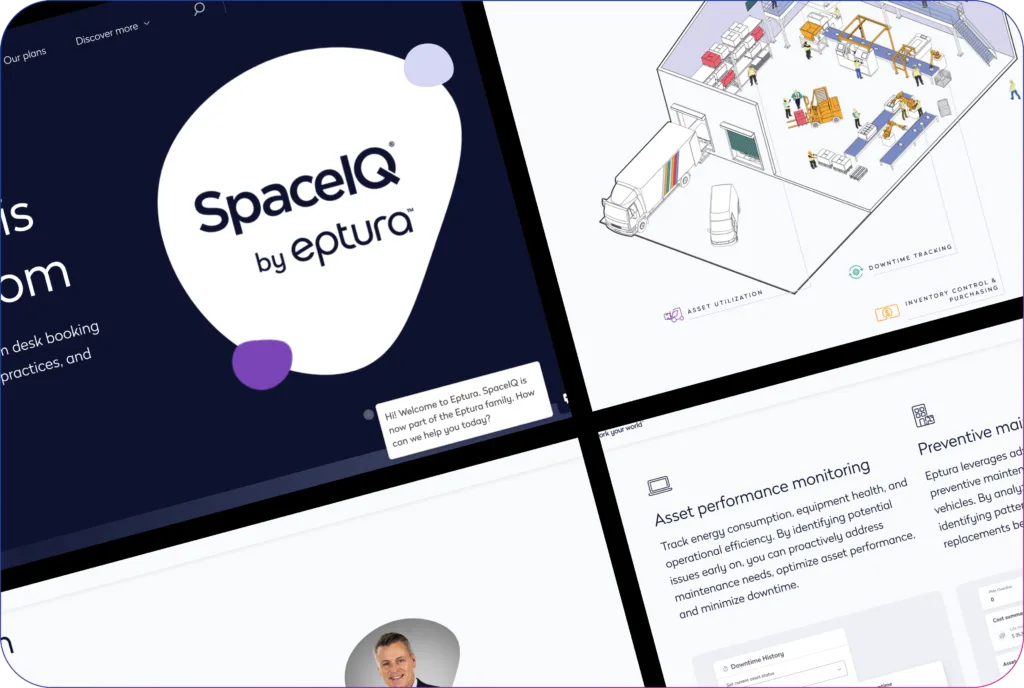
Eptura is one of the world's leading worktech platforms, providing enterprises with a unified system for managing workplaces, people, and physical assets. Formed in October 2022 through the merger of iOFFICE, SpaceIQ, and Condeco — backed by Thoma Bravo and JMI Equity — Eptura brought together decades of category expertise under a single brand. The combined platform now serves more than 16,000 customers across 115 countries, including 40 percent of the Fortune 500, with over 25 million users relying on it daily. Eptura's product suite spans workspace booking, space planning, visitor management, asset maintenance, and intelligent data analytics. As hybrid work models accelerated adoption of integrated workplace management systems (IWMS), Eptura found itself at the center of a rapidly expanding market. With a growing enterprise client base and increasing platform complexity following the three-company consolidation, Eptura needed a development partner that could operate at enterprise scale, integrate seamlessly with its existing engineering organization, and deliver continuously without disrupting live operations serving millions of users worldwide.
Industry
Technology
Service
Staff Augmentation
What We Did
Web and Mobile Application Development
Custom Team
9 Full-Time Equivalents (DevOps, 8 Developers)
Results
Since its launch, the Eptura platform has delivered tangible benefits like
Enhanced User Experience
Ongoing UX improvements across both web and mobile made the platform more intuitive to navigate, reducing friction for the millions of users who rely on Eptura daily for workspace booking, asset tracking, and facility management. Design refinements and frontend performance gains contributed to measurable improvements in user engagement and satisfaction scores.
Platform Scalability
Backend optimizations and infrastructure improvements enabled Eptura to support its expanding client base — onboarding new enterprise customers and scaling to additional geographies without degradation in response times or system reliability. The platform's architecture was strengthened to handle peak loads during high-usage periods across global time zones.
Reduced Downtime
Proactive maintenance, improved deployment processes, and systematic resolution of technical debt significantly reduced platform downtime. Faster rollback capabilities and enhanced monitoring meant that when issues did occur, they were detected and resolved before impacting end users at scale.
Faster Feature Delivery
The embedded team model allowed Eptura to sustain a higher release cadence, shipping new capabilities to enterprise customers faster than would have been possible with internal resources alone. This velocity advantage was especially critical during the post-merger period, when the market window for hybrid workplace features was narrowing and speed to market directly influenced competitive positioning.
Challenge
The consolidation that created Eptura was a bold strategic move, but it introduced significant engineering complexity. Three separate companies — each with its own codebase, deployment pipelines, and development culture — had to be unified into a cohesive product experience. Meanwhile, Eptura's existing customers expected uninterrupted service and a steady cadence of new features. The core challenge was multi-dimensional. On the infrastructure side, the team needed to harmonize backend services and ensure consistent data flows across what had been independent systems. On the product side, the roadmap was aggressive — enterprise clients were requesting advanced space analytics, deeper integrations with building management systems, and mobile experiences that matched the sophistication of the web platform. Every new feature had to work reliably across web and mobile while supporting the scale of a platform handling millions of daily interactions. At the same time, Eptura was navigating the broader shift toward hybrid work. Organizations worldwide were rethinking how they used physical office space, and the demand for real-time occupancy data, flexible desk booking, and predictive space utilization was accelerating. Eptura needed to move fast to capture this market window — but moving fast on a platform serving Fortune 500 enterprises meant that quality, stability, and security could not be compromised. The gap between what the internal team could deliver alone and what the market demanded was widening, and Eptura needed to close it with a trusted engineering partner rather than a rotating cast of contractors.
Solution
Motomtech partnered with Eptura through a Staff Augmentation model, embedding a dedicated team of 9 full-time specialists — including a DevOps engineer and 8 developers — directly within Eptura's engineering organization. Rather than operating as an external vendor, the Motomtech team functioned as an integrated extension of Eptura's own product and platform teams. This embedded model was deliberately chosen for continuity. Enterprise-scale platform work demands deep codebase familiarity, institutional context, and the kind of trust that only builds through sustained collaboration. Motomtech's team participated in Eptura's sprint planning, code reviews, architecture discussions, and incident response — maintaining the same standards, tooling, and delivery cadence as Eptura's internal engineers. The team's contributions spanned both Eptura's web platform and its mobile application, operating across cross-cutting services that support the worktech suite rather than being siloed to a single product line.
Phase 1
Team Integration & Codebase Discovery
The engagement began with a structured onboarding period designed to get the Motomtech team productive within Eptura's engineering workflows as quickly as possible. Each team member was paired with an Eptura counterpart to walk through the relevant codebases, deployment pipelines, and testing frameworks. The DevOps specialist focused on understanding the CI/CD infrastructure, environment configurations, and monitoring stack, while the developers mapped out module boundaries, API contracts, and data models across the web and mobile applications. This discovery phase was critical given Eptura's post-merger landscape. The platform had inherited patterns and conventions from multiple predecessor systems, and understanding where those boundaries existed — and where they needed to be unified — set the foundation for all subsequent work. The technical landscape spanned Eptura's full stack — Java and Node.js powering backend services, React for the web platform, and React Native for the mobile application — and the Motomtech team built fluency across each layer to contribute meaningfully to features that touched multiple parts of the system. By the end of this phase, the Motomtech team was fully embedded: attending standups, picking up tickets, and contributing to code reviews alongside the internal team.
Phase 2
Core Platform Development
With the team fully integrated, Motomtech shifted into sustained delivery mode. The primary focus was implementing features from Eptura's product roadmap — the capabilities that enterprise clients were requesting and that the market was demanding. This included building scalable backend services to support new functionality, enhancing frontend performance across the web platform, and ensuring feature parity between web and mobile experiences. The developers worked across multiple areas of the platform, contributing to both greenfield feature development and improvements to existing modules. Each feature followed Eptura's established development lifecycle: specification review, implementation, automated testing, code review, staged rollout, and production monitoring. The team maintained a consistent velocity that allowed Eptura to meet its commitments to enterprise customers while keeping the technical backlog manageable. Regular alignment with product stakeholders ensured that engineering effort stayed focused on the highest-impact work.
Phase 3
Performance Optimization & Stabilization
As the platform's user base continued to grow, Motomtech dedicated focused effort to performance and reliability. The team identified and resolved bottlenecks in critical user flows, optimized database queries that were contributing to latency under load, and worked with the DevOps engineer to improve deployment processes and reduce rollback times. A significant portion of this phase involved addressing technical debt inherited from the pre-merger codebases. The team refactored components where divergent patterns from predecessor systems were creating maintenance overhead or performance inconsistencies. This work was done incrementally — refactoring alongside feature work rather than as a separate rewrite effort — to avoid disrupting delivery velocity. The result was a more stable, more performant platform that could handle growing traffic without proportional increases in infrastructure cost. Proactive monitoring and alerting improvements also reduced the time to detect and resolve production incidents.
Phase 4
Continuous Delivery & Enhancement
The engagement matured into an ongoing partnership focused on continuous improvement. Motomtech's team continued delivering roadmap features while also responding to evolving customer needs and market shifts. The hybrid work landscape was changing rapidly — new use cases around hot-desking, real-time occupancy tracking, and space utilization analytics were moving from nice-to-have to table stakes for enterprise buyers. The team's deep familiarity with the codebase, built over months of embedded collaboration, allowed them to deliver these capabilities faster than a freshly onboarded team could. Sprint planning incorporated customer feedback, support ticket trends, and competitive intelligence, ensuring that each release delivered measurable value. The Motomtech team also contributed to cross-platform synchronization efforts, ensuring that improvements shipped on web were reflected in the mobile experience and vice versa. This continuous delivery model gave Eptura the sustained engineering capacity it needed to keep pace with one of the fastest-growing segments in enterprise software.
Technology Stack
To ensure a high-performance, scalable, and secure solution, the Eptura platform was built using:
Backend & Infrastructure
Java Node.js C# .NET
Frontend & Mobile
React React Native
Testimonial
"Motomtech's dedication to excellence has been instrumental in advancing our platform. Their team's expertise and proactive approach have significantly contributed to our mission of delivering unparalleled workplace management solutions."
Corey Young,
Director of Engineering, Eptura