

Paramount Acceptance
Building an All-in-One Fitness Platform: How Motomtech Helped Paramount Acceptance Launch Pulse
About Paramount
Paramount Acceptance has been a trusted name in the fitness and wellness industry for over 50 years, providing billing, software, and operational solutions to health clubs across the United States. Their flagship product, Pulse, is a cloud-based all-in-one club management platform designed to handle every aspect of modern fitness operations — from front desk check-in and point-of-sale management to membership billing, amenity scheduling, personal training programs, employee task tracking, lead management, and business analytics. Pulse represents a significant evolution in how fitness clubs operate. Rather than stitching together separate tools for billing, scheduling, CRM, and reporting, Pulse consolidates everything into a single interface. The platform also supports automated email and text communications, corporate wellness programs, commissioning, and integrates with third-party tools like HubSpot for marketing and InMoment for member feedback. For clubs of all sizes — from single-location studios to multi-site chains — Pulse aims to eliminate operational friction so staff can focus on member experience rather than software management. Bringing this vision to life required a development team that could handle the complexity of building a deeply integrated platform from the ground up.
Industry
Fitness
Service
Staff Augmentation
What We Did
Product Conceptualization, Software Prototype, Web & Mobile Development, Maintenance & Enhancement
Small Team
3 Full-Time Equivalent (6 in 1 Business Analyst, UX/UI Designer, DevOps, Quality Assurance, Project Manager, Software Architect, 2 Developers)
Results
Since its launch, the Pulse app has delivered tangible benefits like
Reduction in Platform Complexity
By consolidating scheduling, billing, POS, CRM, reporting, and communications into a single platform, Pulse eliminated the need for fitness clubs to manage multiple disconnected software tools. Club operators reported that day-to-day management became significantly easier, with staff spending less time switching between systems and more time focused on member experience.
Increase in Member Engagement
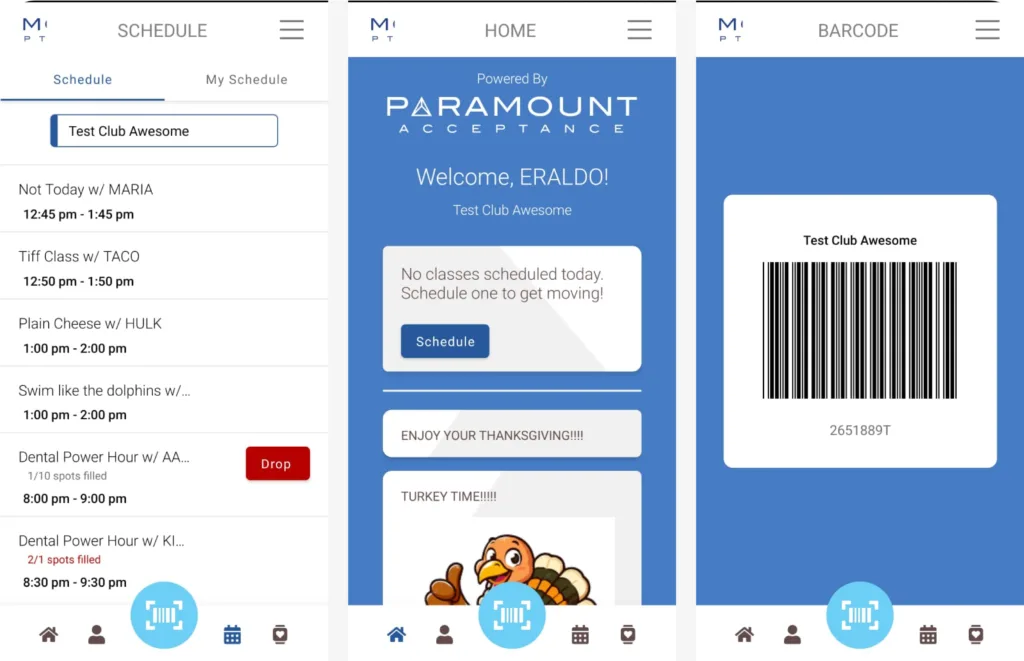
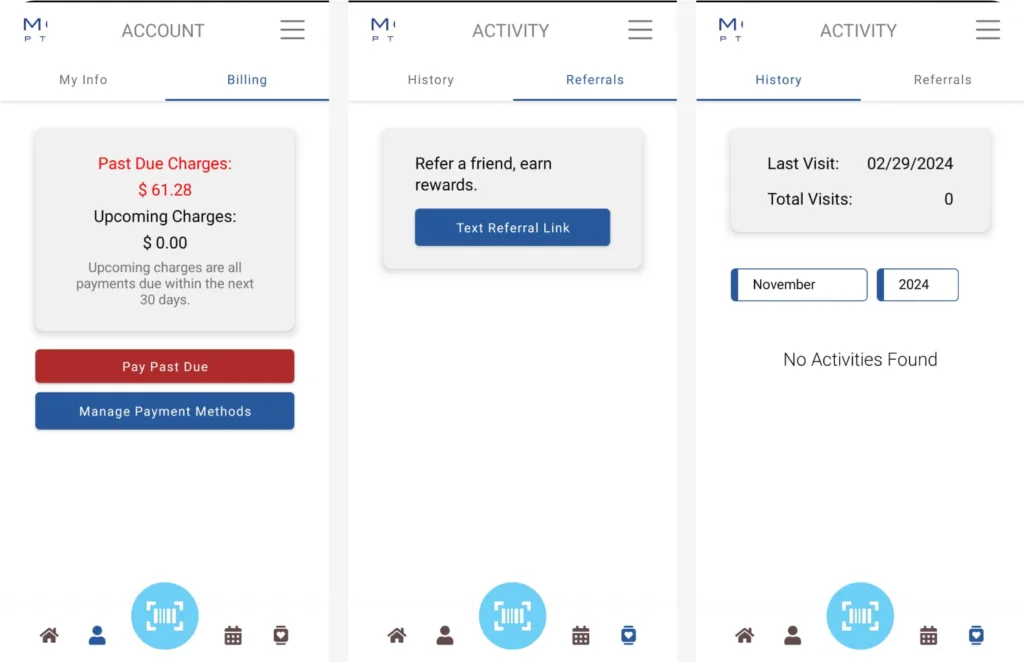
Simplified class scheduling, real-time service updates, and automated member communications led to measurable increases in member engagement. The platform's mobile experience made it easy for members to book classes, manage their accounts, and interact with their club — driving the kind of ongoing digital touchpoints that improve retention.
Boost in Task Tracking Efficiency
Built-in analytics, employee task management, and automated reporting reduced the time club managers spent on administrative overhead. Tasks that previously required manual tracking in spreadsheets or separate tools were now handled within Pulse, with real-time visibility into staff workload, completion rates, and operational bottlenecks.
Faster Rollout of New Features
The architecture Motomtech established in Phase 1 — designed for modularity and extension — paid dividends throughout the engagement. New features could be developed and deployed without destabilizing existing functionality, and the integrated DevOps pipeline reduced the time from code-complete to production. This speed set a strong foundation for long-term scalability as Paramount continues to evolve the Pulse platform to meet the fitness industry's changing needs.
Challenge
Paramount Acceptance had decades of expertise in fitness industry billing, but building a modern cloud-based platform that went far beyond billing was a fundamentally different engineering challenge. The Pulse vision was ambitious: a single system that could replace the patchwork of tools most fitness clubs relied on. Scheduling, point-of-sale, membership management, employee workflows, reporting, communications, and payment processing all needed to work together seamlessly — and all needed to perform reliably at the speed a busy front desk demands. The technical challenge was the breadth of functionality combined with the expectation of simplicity. Each module — billing, scheduling, POS, CRM, reporting — carried its own domain complexity. Payment processing meant PCI compliance requirements. Scheduling meant real-time availability across multiple resource types (rooms, equipment, trainers). Reporting meant aggregating data from every other module into actionable dashboards. And all of it needed to work on both web and mobile, because club staff move between the desk, the floor, and the back office throughout the day. Paramount needed a team that could architect a system this broad without it becoming brittle or difficult to maintain — and that could ship a working MVP quickly enough to get real clubs using it and providing feedback, while also building the foundation for the full feature set that would follow. The fitness industry waits for no one; club owners evaluating software want to see a product that works today, not a roadmap for next year.
Solution
Motomtech joined the project through a Staff Augmentation model, delivering a focused team of three full-time developers to work alongside Paramount's internal team and bring the Pulse platform to life. Despite the compact team size, the engagement covered the full development lifecycle — from architecture design through production support. Each team member operated in a multi-disciplinary capacity, combining roles that larger organizations would split across business analysis, UX/UI design, DevOps, QA, project management, and software architecture alongside core development work.
Phase 1
Architecture & MVP Launch
Motomtech began by designing a scalable software architecture that would serve as the foundation for the entire Pulse platform. This was the most consequential phase of the engagement — architectural decisions made here would determine how easily new modules could be added, how the system would perform under load, and how maintainable the codebase would remain as it grew. The team built a React Native mobile application alongside a web application to ensure a seamless user experience on any device. Given that fitness club staff operate in high-movement environments — checking members in at the front desk, managing classes on the gym floor, reviewing reports in the back office — cross-device consistency was not optional. The team also established a robust DevOps infrastructure to streamline deployment and enable rapid iteration. The goal of this phase was to deliver a Minimum Viable Product that demonstrated Pulse's core capabilities in a real club environment. By keeping the initial scope focused on the highest-value features — membership management, basic scheduling, and front-desk operations — the team was able to get Pulse live and operational, giving Paramount real user feedback to guide subsequent development priorities.
Phase 2
Feature Expansion & Platform Maturity
Following the launch of Pulse's MVP, Motomtech shifted focus to expanding the platform's feature set and hardening it for broader adoption. This phase was driven by a combination of the original product roadmap and feedback flowing in from clubs that were actively using the system. The team added new modules in priority order: enhanced billing and payment processing workflows, point-of-sale functionality, personal training management, employee task tracking, and business reporting dashboards. Each new module had to integrate cleanly with the existing architecture — data from billing needed to flow into reports, scheduling changes needed to trigger automated member communications, and POS transactions needed to reconcile with the financial backend. Regular communication with Paramount's stakeholders ensured that development stayed aligned with what clubs were actually asking for, not just what had been originally planned. As patterns emerged from usage data and support requests, the team adjusted priorities accordingly. User interface refinements were ongoing throughout this phase, with each iteration making the platform more intuitive for the non-technical staff who would be using it daily. Motomtech also provided ongoing technical support, resolving issues promptly to maintain club confidence in the platform during its critical early adoption period.
Phase 3
Ongoing Support & Iteration
As Pulse matured and its customer base grew, the engagement evolved into a sustained support and enhancement model. The Motomtech team continued to ship new capabilities — including third-party integrations, automated communication workflows, and corporate wellness features — while maintaining the stability and performance of the existing platform. This phase also focused on the operational details that separate a working product from a production-grade platform: performance optimization under increasing load, monitoring and alerting for critical payment and scheduling flows, and the incremental reduction of technical shortcuts that had been acceptable during the MVP phase but needed to be addressed as the user base scaled. The team's continuity — the same developers who had built the architecture were now maintaining and extending it — meant that knowledge transfer overhead was zero and code quality remained consistent.
Technology Stack
To ensure a high-performance, scalable, and secure solution, the Pulse app was conceptualized using:
Mobile
React Native
Testimonial
"The reason we chose Motomtech is we needed an alternative to what we have going on already. Once we started working with them their work has been very good, they've been very professional to work with, and we've had great results."
Ren Rice,
CEO, Paramount Acceptance