

One Home Solution
Custom Field-Operations Software for a Multi-Branch Home Services Operator: How Motomtech Built Client, Technician, and Back-Office Applications for One Home Solution
About One Home Solution
One Home Solution is a multi-branch home services operator that delivers home maintenance, regular upkeep, and urgent-repair services through a network of professional technicians across three regional markets — Utah, Orange County California, and Arizona. Their operating model looks familiar to anyone who knows the home-services vertical at scale — a residential customer base that expects transparent scheduling and fast response, a field technician workforce that lives on mobile devices and often in low-connectivity environments, and a back-office team that has to keep bookings, dispatch, invoicing, and payments coordinated in real time across branches and geographies. By the time One Home Solution reached Motomtech, they had hit a wall that is characteristic for operators at their scale: the off-the-shelf vertical SaaS platform they had been running on was no longer a fit. The system could handle the basics, but the mismatch between a generic vendor platform and the specifics of One Home Solution's service model was showing up everywhere — features they did not need cluttering the interface, features they did need missing altogether, and an end-user experience for both staff and customers that was visibly lagging what a modern home-services buyer expects. The decision was to build — not to replace the platform with another off-the-shelf tool, but to commission a purpose-built suite of applications tailored to how One Home Solution actually operates.
Industry
Home Services
Service
Dedicated Product Team
What We Did
Product Conceptualization, Software Prototype, Web & Mobile Application Development, Maintenance & Enhancement, IT Support.
Medium Team
6 Full-Time Equivalent (6-in-1 Business Analyst, UX/UI Designer, DevOps, Quality Assurance, Project Manager, Software Architect, plus 4 Developers)
Results
Since their launch, One Home Solution's apps have delivered tangible benefits like
Unified Operational System
100% seamless integration across the three applications — bookings, technician updates, and back-office coordination flowing through one connected platform rather than a patchwork of point tools.
Client Experience Lift
95% improvement in client satisfaction — the combined effect of transparent real-time communication, AI-powered instant estimates on the client app, and a cohesive customer-facing experience that made engagement with One Home Solution feel modern, predictable, and trustworthy.
Faster Operations
4× faster streamlined operations — service delivery accelerated and cross-team coordination delays minimized once the three-application suite replaced the off-the-shelf platform's friction.
Growth-Ready Scalability
10× growth-ready platform scalability — AWS-backed infrastructure architected from day one to absorb expanding user volumes, additional service categories, and new feature rollouts without re-platforming.
Challenge
The pre-engagement state at One Home Solution is the clearest version of a pattern we see repeatedly with multi-branch home-services operators: the incumbent platform that got the business from one branch to three no longer gets it from three to ten. The off-the-shelf software One Home Solution had been using was functional at a basic level. But "basic" was the ceiling. The workflow customization the business needed — specific to how their technicians scheduled recurring maintenance, how customers requested urgent service, and how the back office reconciled jobs, invoices, and payments across branches — was simply not something the vendor platform was ever going to deliver. Every operational improvement the business wanted to make started with the same conversation: "the software won't let us." The interface compounded the problem. The UI was dated and not intuitive — staff spent measurable daily time on navigation and data entry that should have been automated or streamlined away, and customers on the receiving end saw the same outdated presentation, which undermined the brand's service-quality positioning. And the critical capability gaps — real-time reporting, meaningful task automation, centralized communication across client-facing and field-facing teams — were the kind of gaps you cannot work around indefinitely once the operation scales. The right response was not another platform migration. It was a decision to build custom — a suite of applications purpose-designed for One Home Solution's three distinct user populations (homeowners, field technicians, and back-office staff) and their actual day-to-day workflows, with a scalable cloud infrastructure underneath built to grow with the business rather than constrain it.
Solution
Motomtech partnered with One Home Solution as a Dedicated Product Team — a 10-person engagement structured as six full-time specialists (Business Analyst, UX/UI Designer, DevOps, QA, Project Manager, Software Architect) plus four developers, operating as a self-contained delivery unit. The engagement scope covered the full product lifecycle: product conceptualization, software prototyping, web and mobile application development, and ongoing maintenance + enhancement. The deliverable was not one application — it was three, purposefully separated by user population and purpose, and deeply integrated under a shared back-end so that work flowing between a customer booking, a technician's day in the field, and the back-office team's coordination happened in one coherent system rather than across disconnected tools. AWS served as the infrastructure foundation, chosen for its scalability, security posture, and the breadth of managed services that let the engineering team focus on the business logic rather than on undifferentiated infrastructure work. The One Home Solution build is a flagship example of Motomtech's custom field service management software practice for multi-market home-services operators. The same dispatch, scheduling, and back-office patterns carry over to the single-trade operators we build for in HVAC and plumbing.
Phase 1
Conceptualization
The engagement began with deep discovery. The team conducted structured interviews with three distinct stakeholder populations — internal back-office staff, field technicians, and actual residential customers — because the platform was going to have to serve all three and each one saw a different slice of the business. The insights from those conversations fed a unified product vision that prioritized transparency (customers wanted to see what was happening with their requests in real time), scalability (the platform had to grow with the branch count and service volume), and role-clarity (each user should land in a system calibrated to their actual work, not a single generic interface forced to serve everyone). The conceptualization phase closed with an agreed-upon product architecture: three tailored applications sharing a common data and services layer, rather than one monolithic multi-role interface. That decision set the direction for every subsequent phase.
Phase 2
Software Prototype
With the product vision established, the team moved into prototyping. A comprehensive user journey was mapped end-to-end — from a homeowner's first service request, through dispatch, technician execution, invoicing, and payment — and wireframes were built for each role's primary flows. An interactive prototype then gave stakeholders something they could walk through and react to, which accelerated the feedback loop on usability, role clarity, and cross-device interaction before a line of production code was written. The prototype also served as a contract with the business: everyone — product, engineering, operations, and leadership — had seen the same flows, agreed on the same interaction model, and signed off on the same role separations before development began. That discipline is what kept the Implementation phase from sliding into scope churn.
Phase 3
Implementation — Client App, Technician Field Interface, and Back Office System
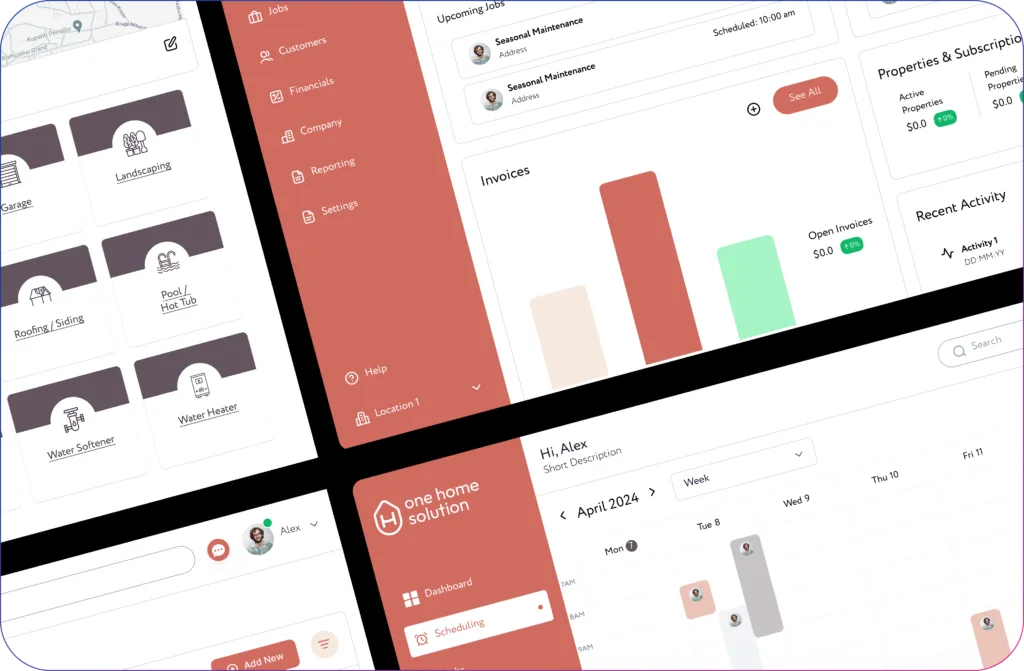
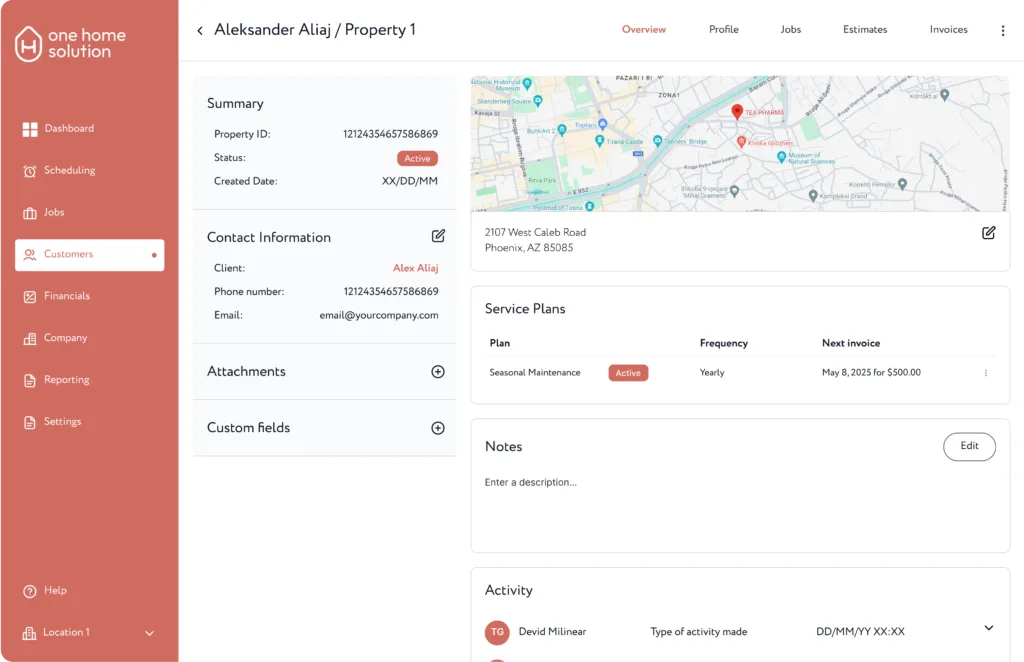
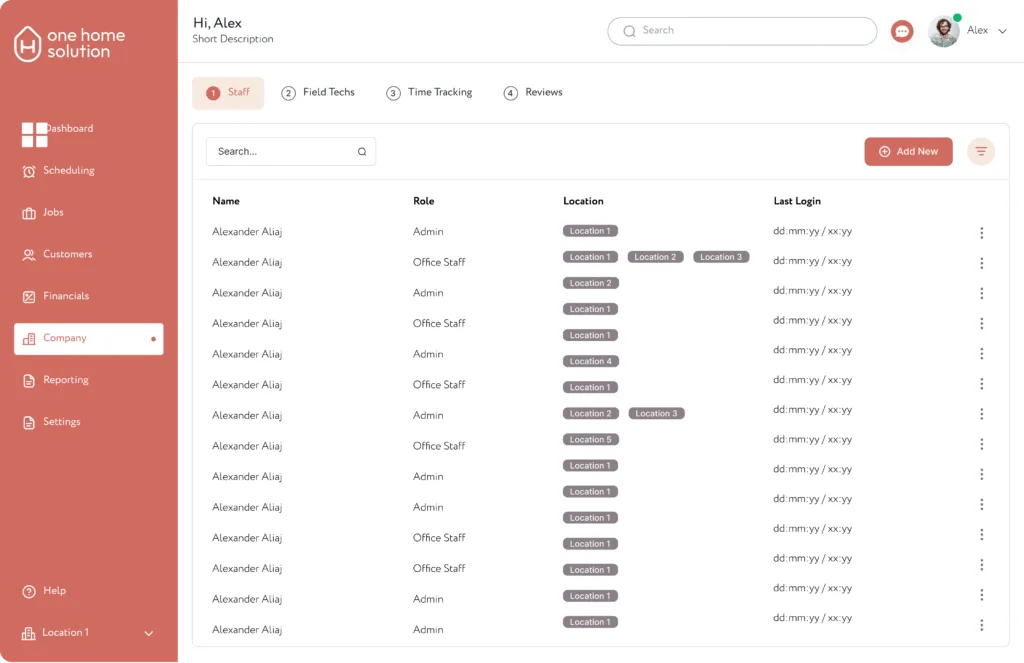
Implementation delivered the three-application suite — each one tailored to its user population, each one deeply integrated with the others. The Client App, available on both web and mobile, gave homeowners end-to-end control of their relationship with One Home Solution. Service requests, appointment scheduling, property management, and payments all lived in one interface. The estimate flow was powered by an AI pricing engine that generated transparent, service-specific quotes in real time — the same pricing intelligence that underlies the back-office dashboard, exposed to the customer as an instant estimate instead of a phone call and a callback. That end-to-end cohesion reframes a home-services vendor from a phone number you call when something breaks to a platform relationship the customer actively uses. Modern home-services buyers expect this; off-the-shelf vertical SaaS does not deliver it. The Technician Field Interface, available on mobile and web, was built for the realities of a dispatched workforce. Technicians could see their schedule, open work orders, capture field data, close jobs, and handle invoicing directly from the field — without context-switching into a separate billing system or waiting to return to the office. The mobile-first design acknowledges that a technician's primary device is their phone and that their primary environment is the field, not a desk. The Back Office System pulled the whole operation into a single centralized dashboard. Customer data, service requests, job scheduling, employee oversight, financial operations, and — critically — an AI pricing engine all surfaced to the back-office team in one place. The pricing engine gave operators live, data-informed quote generation and service-category pricing intelligence, replacing the static rate-sheet model that had been the ceiling of the previous off-the-shelf platform. The same engine powers the Client App's instant-estimate experience, so a price a customer sees on web or mobile is the same price the back office is working from — no sync gaps, no reconciliation delay. Dispatch became a first-class action rather than a series of workarounds; reconciling field work to invoicing to payment became a continuous flow rather than a recurring manual reconciliation exercise, and the real-time reporting layer gave operators visibility that the previous platform had structurally lacked. Each application was designed around the responsibilities of its user while sharing the same underlying services and data layer as the other two. That architectural decision — three tailored interfaces, one integrated core — is what distinguishes purpose-built field-operations software from an off-the-shelf platform with bolt-on modules.
Phase 4
Maintenance & Enhancement
The engagement did not end at launch. Motomtech moved into an ongoing maintenance and enhancement partnership — the pattern that custom-built field-operations software requires if it is going to continue to outperform the off-the-shelf alternative it replaced. Feature evolution, operational telemetry, performance optimization, and infrastructure tuning all continued as the operating business evolved. The result of the full engagement was a suite of applications that One Home Solution owns, operates, and continues to shape — a secure, scalable, and fully tailored field-operations platform that supports the business's growth rather than constraining it, and that gives every team (customer service, field operations, back office) the tools their actual work requires.
Technology Stack
To ensure a high-performance, scalable, and secure solution, One Home Solution's apps were built using:
Backend & Infrastructure
Node.js Ruby on Rails AWS Fargate Amazon S3 Amazon RDS Postgres Amazon VPC Elastic Load Balancing (ELB) Amazon Route 53 AWS IAM AWS KMS AWS WAF Amazon API Gateway AWS Lambda (if needed) Amazon SNS Amazon CloudWatch GitHub Amazon CloudFront Amazon ECR
Frontend & Mobile
React React Native
Testimonial
"Motomtech's expertise in developing our Home App has transformed the way we deliver services. Their dedication to understanding our needs and delivering a tailored solution has significantly enhanced our client satisfaction and operational efficiency."
Peter Rosholt,
CEO, One Home Solution